
What you’ll learn
- How the board, triage and the access-target clock actually work, so you can pick up your next patient with confidence.
- What to present to your senior, and when, so every discharge is a safe one.
- Twelve common presentations worked through: what to ask, what to look for, and when to get help.
- How to refer to inpatient teams without the pushback.
- What to do when things get hard: aggression, the patient who wants to leave, and the bad shift.
- Checklists for your phone, ready for your first shift.
Who it’s for
For FY1s and FY2s starting an emergency rotation, and final-year students who will be soon. Written for UK emergency departments: streaming and triage, the four-hour standard, and UK roles, terms and support services.
It’s short on purpose: about an hour to read cover to cover. Read chapters 1 to 4 and 11 before your first shift. Keep chapters 5 to 7 and the quick reference on your phone for the shift itself.
Who’s behind it
Edited and clinically reviewed by Dr Nick McIntosh, BMedSci MBBS(Hons), Emergency Medicine Senior Registrar (ACEM). Every title is reviewed at least once a year, and corrections go out to every buyer free. See what’s changed.
What’s inside
- Welcome to the emergency departmentWhat the ED does, who you’ll see, and what it feels like.
- How a shift runsThe board, triage, the clock, senior review before discharge, and getting your breaks.
- Your teamDoctors, nurses, practitioners, pharmacists and everyone else on the floor.
- Your jobThe loop, presenting to your senior, disposition, notes and prescribing safety.
- Key skillsSick or not sick, the focused assessment, ECGs, imaging, safety-netting.
- Common casesTwelve presentations, from chest pain to the febrile child.
- Calling for helpYour triggers to escalate, and your role in resus.
- When things get hardAggression, distress, mistakes and difficult conversations.
- The legal bitsCapacity, consent and keeping a patient safe.
- Looking after yourselfShift work, nights and the body clock.
- Finding your feet fastYour first week, and how to get good quickly.
The twelve cases
- Chest pain
- Shortness of breath
- Abdominal pain
- Collapse and syncope
- Head injury
- Sepsis
- The older person after a fall
- Overdose and poisoning
- Mental health presentations
- Limb injuries in fast track
- The febrile child
- The patient who wants to leave
Read a free sample
The first chapter and two of the common cases, free. No sign-up.
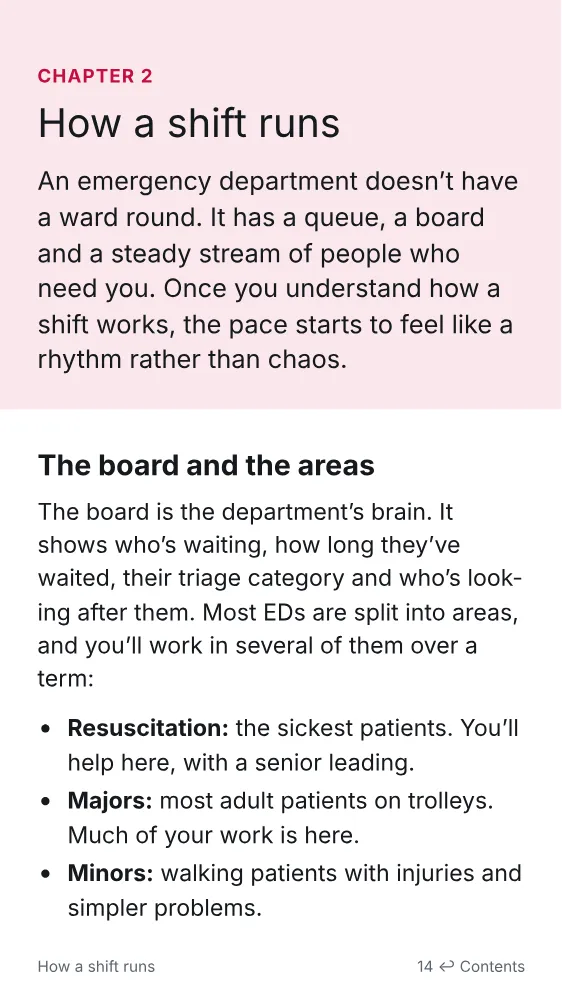
Every chapter starts with how it works
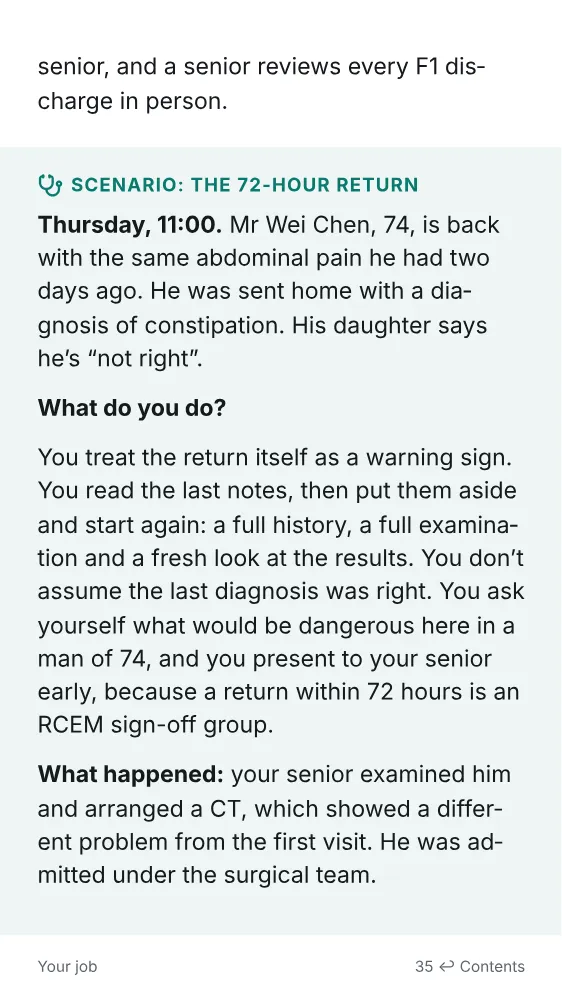
Scenarios: what you do, and why
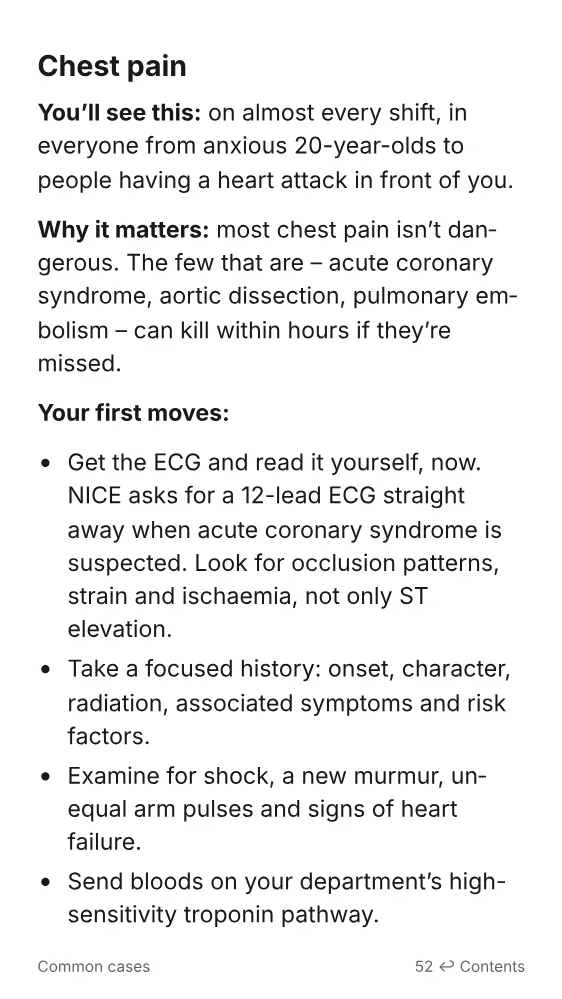
Twelve common cases, worked through
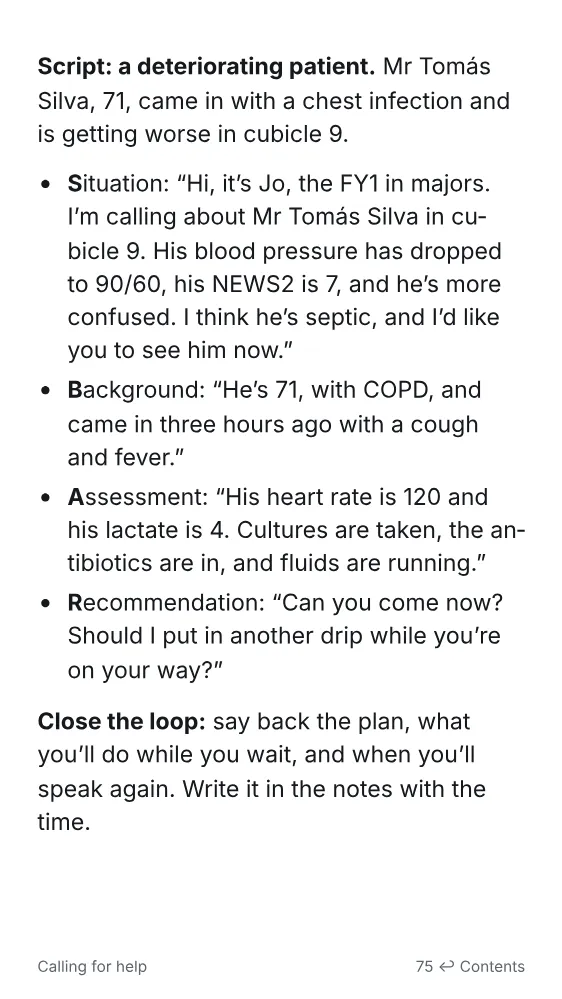
Scripts for the calls you’ll make
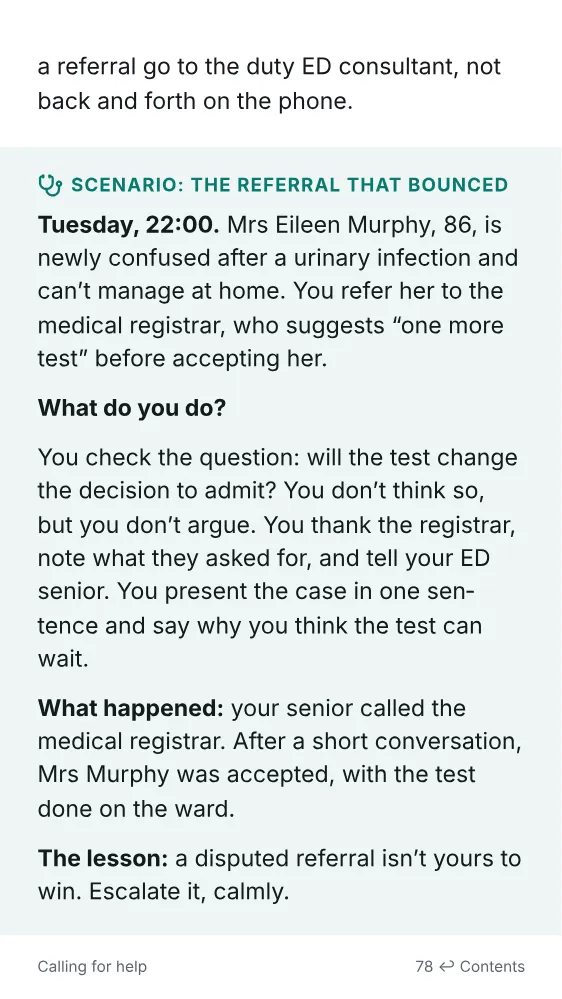
What to do when a referral bounces
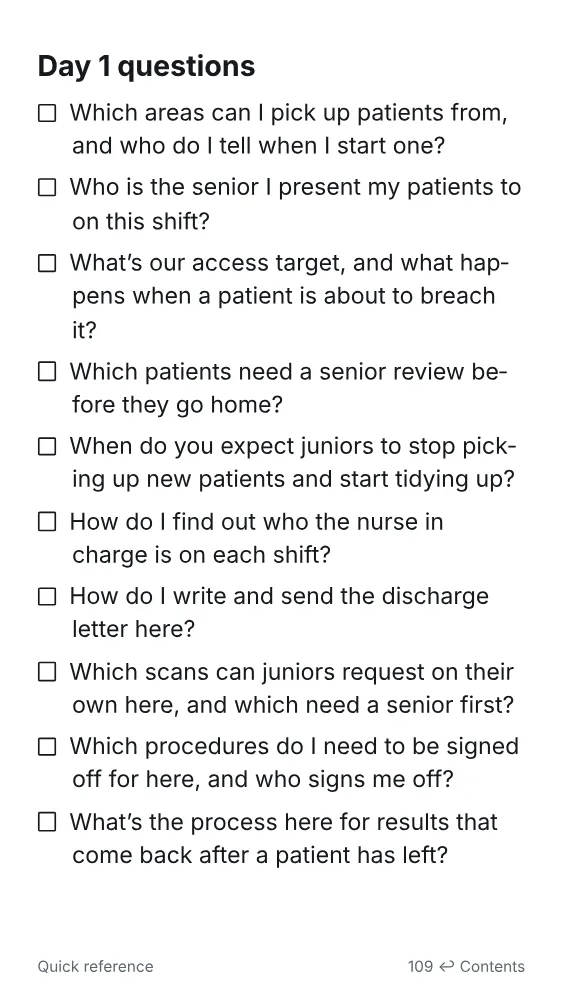
Questions to ask on day 1


Free guide: A&E survival guide for FY1s
An A&E survival guide for FY1s: how the department works, picking up patients, working with nurses, and your first week, shift by shift.
Questions
What do I get?
A phone-ready PDF, laid out for a phone screen so there’s no pinching and zooming, and an EPUB for Apple Books, Google Play Books, Kobo, or Kindle through Send to Kindle. Both stay in your library, with every future version free.
Does it give drug doses?
No. It shows you how to think and points you to your local protocols and formulary. Local guidance always wins.
What if it isn’t for me?
Email [email protected] within 14 days of buying and we’ll refund you in full. No questions asked.
Why does my statement say LINK.COM?
Payments are processed by Stripe through Link, which handles tax and receipts for us. Your statement will show LINK.COM* GETSTARTEDMED.
More in the FAQ.
Get Started in Emergency, UK Edition
Important
This book is an educational orientation guide for qualified doctors and senior medical students. It does not replace your hospital’s guidelines, policies or formulary, the advice of your supervisors, or your own clinical judgement. Practice varies between hospitals, health services and regions, and guidance changes. Always check local protocols, and check any medicine, dose and route against your local formulary before prescribing or giving it. If in doubt, ask a senior colleague. The case scenarios in the book are fictional composites. No hospital, health service, college, university or regulator has endorsed it.Full disclaimer.