
Edited and clinically reviewed by Dr Nick McIntosh, Emergency Medicine Senior Registrar
What’s inside
Your first night on call is a rite of passage, and almost everyone finds it daunting. You cover wards you don’t know, for patients you’ve never met, and most of your decisions start on the phone. This guide gives you a way to handle it.
Triage your calls in the first minute
Six questions to ask the nurse on every call, and a simple rule for deciding what needs you now, what can wait a little, and what can be batched.
Ten calls, worked through
Fever, chest pain, breathlessness, low blood pressure, falls, confusion, low urine output, a high potassium, a low or high blood glucose, and confirming a death. For each: what to ask, when to go, your first moves, and when to call for help.
Know when to call your registrar
Firm triggers, so you never have to guess, and a short script that makes the call quick and clear.
Checklists for your phone
A pre-shift checklist, a phone triage card and a handover template, ready to screenshot.
Made for your phone, at 3 am
Real pages from the guide. Short chapters, big type, and no pinching and zooming.
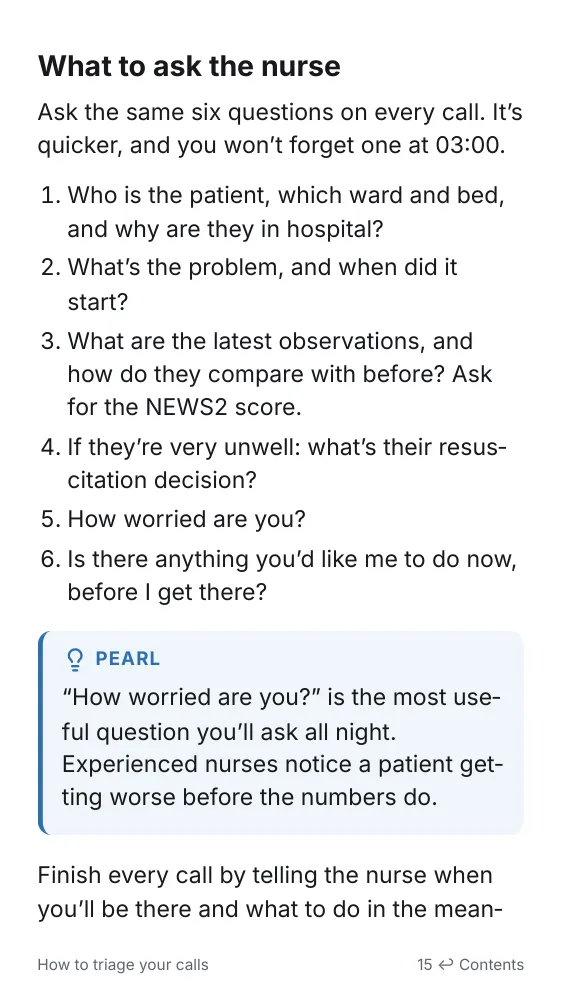
The six questions for every call
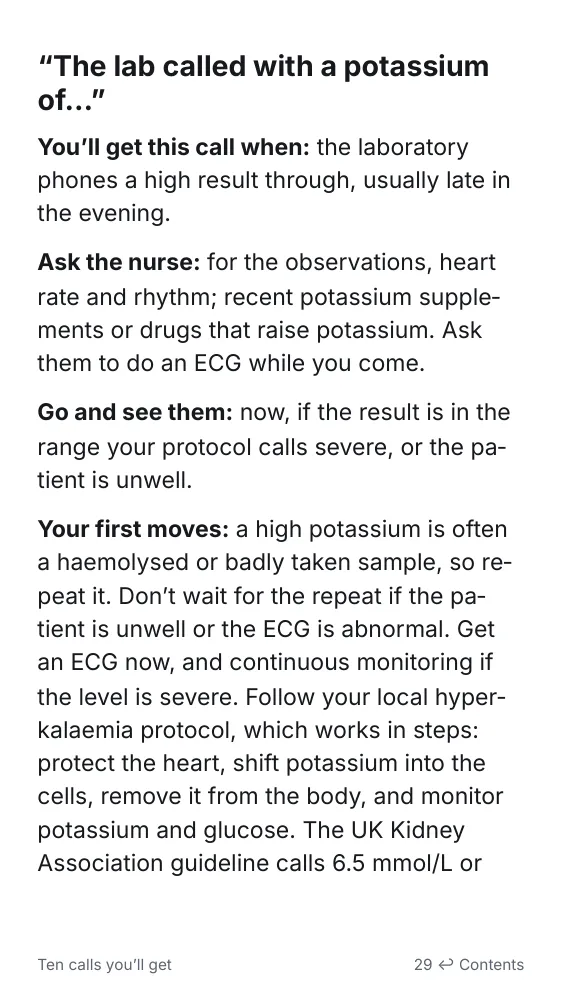
Ten common calls, each worked through
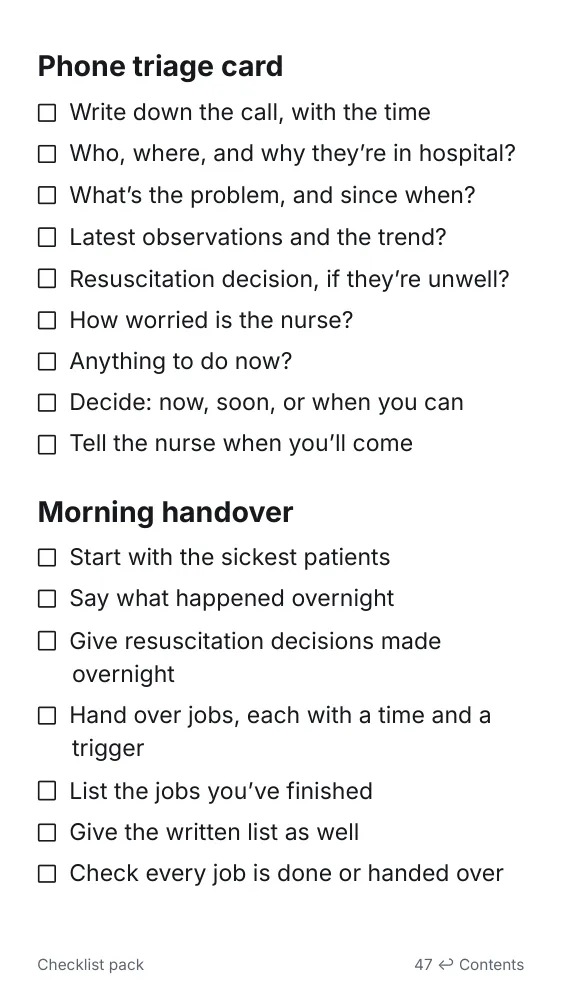
Checklists to screenshot


Who it’s for
For FY1s and FY2s about to start ward cover out of hours, and final-year students who will be soon. It works whatever rotation you’re on.
What it isn’t
It isn’t a textbook, and it doesn’t give drug doses. It helps you think through each call, then points you to your local protocols, your formulary and your seniors. Local guidance always wins.
Read it the week before your first night.
Free, about 20 minutes, and it stays on your phone for the nights after.
Get the free guideQuestions
Is it really free?
Yes. Confirm your email address and we’ll send you the guide straight away.
Will you fill my inbox?
No. Without the box ticked you only get the confirmation email and your download link. Tick it and we’ll also send the occasional tip and news of new guides, timed to your next rotation. Every email has a one-click unsubscribe.
Which edition should I get?
This is the UK Edition, written for UK hospitals and their terms, roles and support services. Working in Australia? Get the Australian Edition.
Can I read it on my phone?
Yes, that’s what it’s for. The PDF is laid out for a phone screen, so there’s no pinching and zooming. There’s also an EPUB for Apple Books, Google Play Books, Kobo, or Kindle through Send to Kindle.
Does it give drug doses?
No. It shows you how to think through each call and points you to your local protocols and formulary for doses. Local guidance always wins.
Who’s behind it?
It’s edited and clinically reviewed by Dr Nick McIntosh, BMedSci MBBS(Hons), Emergency Medicine Senior Registrar (ACEM), and published by Get Started Medicine, which makes short, practical guides for doctors starting a new rotation.